Western Blot: wet blot: Difference between revisions
Jump to navigation
Jump to search
Created page with "{| class="wikitable" |+ !Materials ! |- |Western Transfer Buffer |dissolve 6.0 g Tris Base; 28.8 g glycine in 1 L dH<sub>2</sub>O add 430 mL methanol and degas for 30 min while stirring after degasing, add 10 mL 20% SDS and fill up to 2 L with H<sub>2</sub>O |- |Blocking Solution |TBS-T; 2% BSA; 0.05% NaN<sub>3</sub> |- |TBS-Tween |200 mL 10x TBS; 10 mL Tween; ad 2 L H<sub>2</sub>O |- | |First and second Antobody |- | |ECL-Medium |- | |H<sub>2</sub>O<sub>2</sub> (30%) |-..." |
No edit summary |
||
| Line 16: | Line 16: | ||
|- | |- | ||
| | | | ||
|First and second | |First and second Antibody | ||
|- | |- | ||
| | | | ||
Latest revision as of 15:24, 27 February 2025
| Materials | |
|---|---|
| Western Transfer Buffer | dissolve 6.0 g Tris Base; 28.8 g glycine in 1 L dH2O
add 430 mL methanol and degas for 30 min while stirring after degasing, add 10 mL 20% SDS and fill up to 2 L with H2O |
| Blocking Solution | TBS-T; 2% BSA; 0.05% NaN3 |
| TBS-Tween | 200 mL 10x TBS; 10 mL Tween; ad 2 L H2O |
| First and second Antibody | |
| ECL-Medium | |
| H2O2 (30%) | |
| Staining Solution | 250 mL isopropanol; 100 mL acetic acid; 650 mL H2O; 0.03% Coomassie |
| Destaining Solution | 10% (v/v) isopropanol, 10% (v/v) acetic acid |
Procedure
- The PVDF membrane is labeled with a pen and quickly activated in methanol, then soaked in Western transfer buffer.
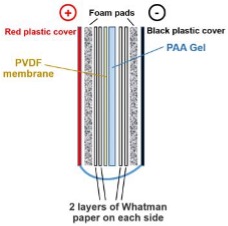
Schematic structure of a WB sandwich. - The transfer chamber is assembled according to the instructions of the supervisor: The Western Blotting stack is assembled by placing a Wet Blotting clamp with the red side down in a plastic container filled with Western Transfer buffer. Place a foam pad followed by two Whatman papers on the red plastic cover. Place the PVDF membrane on the stack and put the PAA gel on top of the membrane. Place two Whatman papers on the gel and remove any bubbles trapped between the layers using a roller Top the stack with a black foam pad and close the Wet Blotting clamp and place it with the red plastic cover towards the anode (+) in the transfer chamber.

- The blot is connected to a power supply and the proteins are transfered over night at room temperature at 30V or for 2h at 200mA with cooling.
- Upon completion of transfer, the apparatus is disassembled and the membrane is further processed as described in “Western Blot: probing of the membrane”.